Released: September 2026
The hour you keep spending on the wrong thing
Everyone has an hour in the day when the hard problem is easy, and an hour when the same problem is a wall. Almost nobody can say when those hours fall. We know we are “a morning person”, roughly, and then we spend the morning on email.
MakeTimeFlow used to ask about your energy exactly once: three chips after a focus session ended. Between sessions, the day was dark, and the answer went into a chart nobody looked at.
A slider on Focus, and the shape of your day
On the Focus page, just above the Flow Coach, there is now a one-line Energy bar: a sparkline of today, your latest reading, and the word for it. Hover over it (tap, on a phone) and the full strip opens.
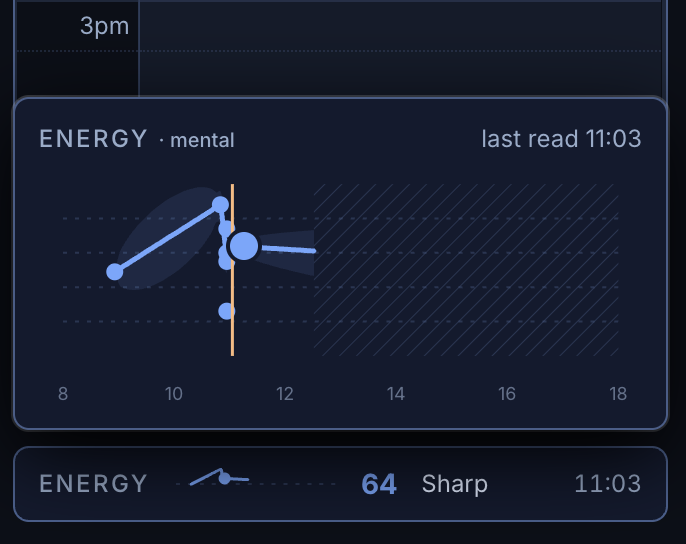
Drag the slider on the “now” line to where you are. That is a reading. The scale is 0 to 100, and five words name its bands: Brain-dead, Foggy, Steady, Sharp, Peak. Every one of them is about how clear your thinking is, never about how motivated you feel. You cannot honestly answer Sharp because you went to the gym.
Between your readings the line is an estimate, shaped by what you were doing. A focus session pulls it down, a scheduled block more gently, the half hour after either recovers some of it, open time slopes off slowly, and then the line lands on your next reading. The shaded band under the line is how much of that is guesswork: zero at every dot, wider between them. The line between two readings is never a fact, and the band is what stops it looking like one.
Ahead of your latest reading the line runs on for ninety minutes and stops. Past three hours the strip goes grey. Nothing nags you. The fading is the whole reminder.
The reading is small. The rhythm is the point.
The three chips after a focus session are still there, relabelled Foggy / Steady / Sharp so they measure the same thing the slider does, and they now carry the session with them. Begin Well asks once in the morning, so the day starts with an anchor. Forgot to record something? Tap the hour on the graph and move the slider; the reading is dated to that hour and marked as recalled.
Data → Energy shows your readings by hour of the day and by day of the week. Two weeks of a few readings a day and the shape is there: the peak you were spending on email, the trough you were forcing hard work through, the afternoon that recovers if lunch had a walk in it.
That makes it an instrument for a Personal Experiment. Does a walk at lunch buy back the afternoon? One week without, one with, and the 2–4pm stretch answers. What does a ninety-minute session cost me compared with fifty? The after-session question settles it over a fortnight.
Three readings a day is plenty
This is easy to overdo. The morning question, the after-session question, and a slider move when you notice a real change will draw the shape of your day. Missing readings widen the band; they do not break anything.
Your coach sees your latest reading and how fresh it is, and treats the line between readings as a guess it may ask you about, never as something you told it.
How this helps you level up
Your best hours are the scarcest thing you have, and until now you were placing them by feel. Two weeks of readings replaces the feel with a shape, and once you can see where your sharpest hours fall, protecting them for the work that matters is the most direct level-up there is.
Full guide: Mental Energy.
What’s next
Recording a reading by voice, or by telling the coach, is designed and waiting on the next round of AI work. And once enough readings exist, the strip will be able to show you a second line: what your day usually looks like at this hour, so the surprise is visible when today is different.